TWO:The French hastened to comply with this condition, on the understanding that Ormonde would immediately draw off his troops from Quesnoy; and the duke was obliged to announce to Prince Eugene that he was under this necessity, in consequence of the terms agreed upon between France and England; in fact, that he must cease all opposition to the French. Ormonde, therefore, not only gave the command for the retirement of the English troops, but also of all those belonging to the German princes which were in British pay. Eugene and the Dutch field deputies protested most indignantly against this proceeding, and the mercenary troops themselves refused to follow Ormonde. In vain did he endeavour to move the officers of those troops; they despised the conduct of England in abandoning the advantageous position at which they had arrived for terminating the war gloriously, and releasing the common enemy of Europe from his just punishment to gratify party spirit in England.
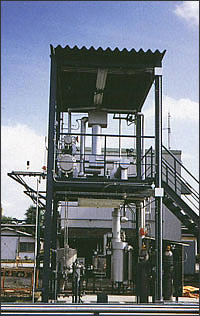
Great attention is recently being paid to global environmental issues, and it is now conceivable that companies will need to treat used solvents themselves. In consideration of this kind of social issue, we have developed a “membrane separation type solvent dehydration system,” which uses a polyimide membrane with superior dehydration properties developed by Ube Industries, Ltd. in combination with our own distillation and concentration technology that has resulted in solvents being more easily recovered.
THREE:
- 1Under the distillation system, even in case of azeotropic solvent compositions, this system which remove water vapor by the polyimide membrane will easily dehydrate.
- 2In comparison with the distillation system, it significantly saves on use of steam.
- 3Dehydration can be performed through merely supplying evaporated vapor to the membrane module and maintaining the differential pressure between the permeable side and the impermeable side.
- 4Solvent purity of 99.9% or more can be achieved by carrying out dehydration with a polyimide membrane only.
- 5The polyimide membrane has superior heat and solvent resistance. Therefore, the vapor permeation system reduces contamination of the membrane and thus extends its life.
THREE:
The aromatic polyimide membrane is highly permeable to water vapor but less permeable to vapors of organic compounds such as alcohol etc.
THREE:[502]It was time, if they were to avoid a battle. Cumberland was already on the march from Edinburgh. He quitted Holyrood on the 31st of January, and the insurgents only commenced their retreat the next morning, the 1st of February, after spiking their guns. With this force the prince continued his march towards Inverness, a fleet accompanying him along the coast with supplies and ammunition. On nearing Inverness, he found it rudely fortified by a ditch and palisade, and held by Lord Loudon with two thousand men. Charles took up his residence at Moray Castle, the seat of the chief of the Macintoshes. The chief was in the king's army with Lord Loudon, but Lady Macintosh espoused the cause of the prince zealously, raised the clan, and led them out as their commander, riding at their head with a man's bonnet on her head, and pistols at her saddle-bow. Charles, the next morning, the 17th of February, called together his men, and on the 18th marched on Inverness. Lord Loudon did not wait for his arrival, but got across the Moray Firth with his soldiers, and accompanied by the Lord-President Forbes, into Cromarty. He was hotly pursued by the Earl of Cromarty and several Highland regiments, and was compelled to retreat into Sutherland. Charles entered Inverness, and began to attack the British forts. Fort George surrendered in a few days, and in it they obtained sixteen pieces of cannon and a considerable stock of ammunition and provisions.
- 1 Recovery of the detergent solvent Recovery of the cleaning solvent such as electronic parts industry, precision instrument industry.
- 2Solvent recovery and the refinement Solvent recovery and the refinement such as chemical industry, an industry of medical supplies, food industry, the fermentation industry.
THREE:Scarcely was the Prince married, when he began to complain of his limited income. His father, as Prince of Wales, had been allowed one hundred thousand pounds from the Civil List, which then was only seven hundred thousand pounds, but he now received only fifty thousand pounds from a Civil List of eight hundred thousand pounds. Bolingbroke, two years before, on leaving England, told the prince, as his parting advice, to apply to Parliament, without any regard to the king, for a permanent income of one hundred thousand pounds a year. Under these circumstances, Walpole persuaded the king to send a message to the prince, offering to settle a large jointure on the princess, and to make the prince's own income independent of his father. Here the prince ought to have yielded; if he had been either politic or well-disposed, he would have done so. The king was at this time very ill, and his physicians declared that if he did not alter soon, he could not live a twelvemonth. This circumstance of itself would have touched any young man of the least natural feeling, to say nothing of policy; for, if the king died, there was an end of the question¡ªthe prince would be king himself. But he was now in such a temper that he would not listen to the royal proposal; and the next day, the 22nd of February, 1737, Pulteney made his motion in the House of Commons for an address beseeching the king to settle upon the prince a hundred thousand pounds a year, and promising that the House would enable him effectually to do so. What was still stranger, it was seconded by Sir John Barnard. The[68] Commons were not willing to run counter to a prince apparently on the point of ascending the throne, and Walpole would have found himself in a minority had Wyndham, as he hoped, brought the Tories to vote for the prince. But forty-five Jacobites, who could not bring themselves to vote for an heir of the House of Hanover, though they would by that have done a serious mischief to the Hanoverian usurper, as they styled him, rose in a body and quitted the House. On the division, the Ministerial party amounted to two hundred and thirty-four, the Opposition to only two hundred and four¡ªbeing a majority for Ministers of exactly thirty. The next day the same motion was made in the Lords by Carteret, but was rejected by a large majority¡ªone hundred and three to forty.Father, with panting breast,
Acetone, ethanol, methyl ethyl ketone, butanol, isopropyl alcohol, ethyl acetate, methyl isobutyl ketone, others (including hexane and toluene).
